

Sunbury residents have just two weeks to have their say on a Victorian Government proposal that could change the future of a large open green space at Jacksons Hill.
Public consultation opened on 26 June and closes 12 July 2026 for Draft Planning Scheme Amendment C283hume (PDF), which proposes rezoning part of the former Victoria University Sunbury campus from Public Use Zone to Mixed Use Zone.
The amendment applies to approximately 11 hectares of land in the central Jacksons Hill precinct, generally bounded by Circular Drive. The area is currently undeveloped open space and has been identified in the Jacksons Hill Master Plan (2018) as a future mixed-use precinct.
According to the Department of Transport and Planning, the land has been declared surplus to the Victorian Government’s needs and, under the Victorian Government Land Transaction Policy, must be rezoned before it can be sold.
Podcast commentary here.
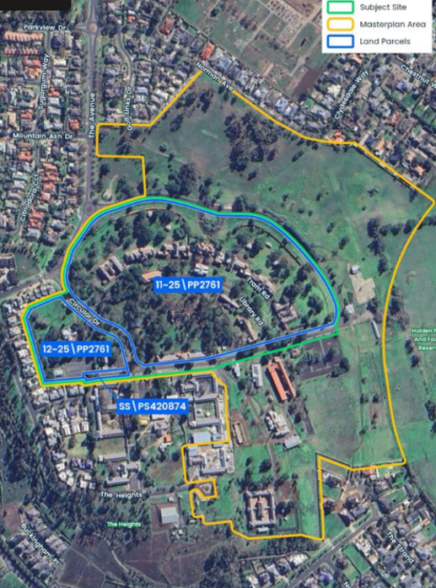
If approved, the amendment would establish the planning framework for future residential and mixed-use development, supporting a greater diversity of housing in line with the master plan. The proposal itself does not approve any specific development but would enable the land to be sold and considered for future projects.
The draft amendment also proposes applying an Environmental Audit Overlay to the site to ensure any future development addresses environmental requirements associated with its previous institutional use.
Consultation process
The Minister for Planning is considering using powers under the Planning and Environment Act 1987 to exempt the amendment from the usual public exhibition process. Instead, a consultation process is being undertaken under Section 20(5) of the Act before a decision is made.
All submissions received during the consultation period will be considered by the Minister before determining whether to approve the amendment.
A significant site for Sunbury
The land forms part of the former Victoria University campus, which operated between 1994 and 2009 before closing in 2011. The Victorian Government purchased the site in 2018, and the current proposal represents the first stage of implementing the long-term Jacksons Hill Master Plan.
Given the significance of the precinct and its role as one of Sunbury’s best-known heritage and residential areas, the proposal is expected to attract strong community interest.
Key dates
- Consultation closes: 12 July 2026
- Assessment of submissions: Mid July 2026
- Minister’s decision: August 2026
- Decision announced: Late August to September 2026
Residents wishing to comment on the proposal can lodge a submission through the Victorian Government’s Engage Victoria consultation before the deadline.
Jackson Hill site requires contamination assessment before redevelopment
A contamination review has found part of the former Jackson Hill campus does not currently meet environmental criteria for sensitive land uses, with further assessment and remediation required before redevelopment can proceed.
A site contamination review prepared for the Department of Transport and Planning has found land at the former Jackson Hill campus in Sunbury is considered “potentially contaminated land” and will require further assessment before it can be used for sensitive purposes such as residential development.
The review, prepared by environmental consultants Landserv, examined Lot 2044 and Lot 12, which the department has identified as surplus land and is considering rezoning from Public Use Zone to Mixed Use Zone.
Landserv said the review was undertaken to support the planning scheme amendment process and assess whether the land met the requirements of Ministerial Direction No. 1 and Planning Practice Note 30.
The report notes that previous uses of the site included the Sunbury Industrial School, a mental hospital and later a tertiary education and TAFE campus.
At the time of the review, laboratory analysis had only been completed for Lot 2044.
Based on those results, contamination was identified primarily within shallow fill and in localised deeper soils, particularly around Building 6 and the underground storage tank area at Building 11. Elevated concentrations of lead, total recoverable hydrocarbons and benzo(a)pyrene exceeded assessment criteria adopted for the protection of human health and the environment under a sensitive land use scenario.
The report also identified asbestos-containing material in fill at two investigation locations near Building 6 and on the ground surface between Buildings 43 and 44 and at Building 29. Laboratory testing confirmed the presence of chrysotile, crocidolite and amosite asbestos fibres. Mapping of underground services also confirmed one asbestos-containing service, with the report conservatively assuming underground services across the site contain asbestos.
Landserv concluded the site does not currently meet the criteria for sensitive land uses without further assessment and remediation.
“Based on the findings of this review, the site is considered to be potentially contaminated land,” the report states.
The consultants said the contamination reflects historical activities at the site, including the storage of liquid fuel in underground storage tanks and the presence of imported fill.
Despite those findings, the report concludes the land can be made suitable for sensitive land uses through further detailed assessment, remediation and appropriate management measures.
However, it says a full environmental audit is not practical at this stage because existing buildings, including heritage buildings, and site infrastructure limit the ability to fully investigate contamination, while future precinct boundaries and land uses have not yet been finalised.
Instead, the report recommends applying an Environmental Audit Overlay as part of the planning scheme amendment process. The overlay would require environmental assessment and, where necessary, remediation before the land could be demonstrated to be suitable for its intended future use.